
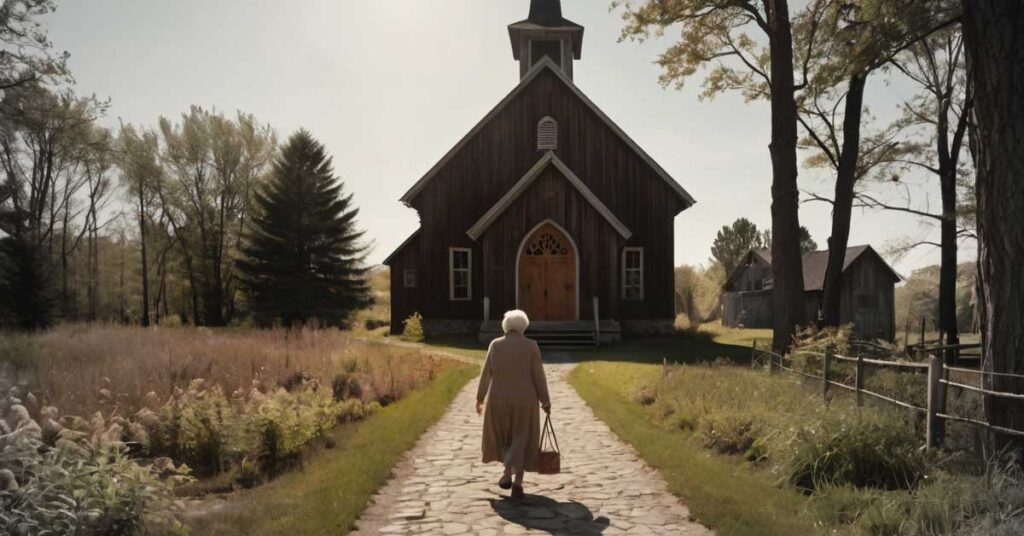
In the heart of New England, nestled within a small town, two United Church of Christ (UCC) churches stand as remnants of a bygone era. One, a “town folk church,” and the other, a “farm folk church,” both are witnesses to a rich history that has now faded into decline. Years ago, a friend of mine served as an interim pastor at one of these churches and confronted a pivotal moment in its legacy—the proposal of a merger. As she shared her experience with the church council, it became evident that change often meets resistance. One story she recounted particularly resonated with me: a council member, visibly disturbed by the idea of merging, led her to a seemingly ordinary wall within the meeting house. With a palpable sense of reverence, he pointed and declared, “Do you see that wall? My great-great-grandmother hammered a peg in that wall with her own hands. There is no way I would ever agree to leave this building.” In that moment, the significance of a simple peg became a metaphor for the deep-seated attachments we form to our past.
Pegs, in their essence, are more than just wooden fasteners; they represent the connections and histories that bind us to our traditions. During my own experiences in renovating the steeple of a church I once led, I was introduced to the intricate craftsmanship of 18th-century construction. I marveled at the numerous tapered and faceted wooden pegs that held the structure together, without the use of nails or spikes. These pegs are testaments to a bygone era, providing stability and strength to buildings that have withstood the test of time. However, in a metaphorical sense, pegs can also symbolize the barriers we erect in the name of tradition—barriers that may obstruct our path to renewal and growth.
These pegs take many forms: perhaps it is an attachment to a specific style of music, an organ that has long been cherished, or the familiar hymnal that has accompanied generations. They could be the cherished tableau at Christmas, the candles that adorn the chancel, or a seat on a board of power and influence. Sometimes, they even manifest as a steadfast commitment to a trinity of our own making: tradition, endowments, and buildings. Yet, as stewards of our faith communities, it is vital to examine what lies behind these walls of resistance. What are the pegs we cling to? Are they truly upholding our mission, or are they hindering our growth and evolution?
Every congregation faces its unique set of challenges, yet I believe that all share a common desire to thrive. The love for our sacred spaces—where baptisms, weddings, funerals, celebrations, and countless cherished moments have occurred—is palpable. However, clinging to the past will not revive the vibrancy we once knew. The ministry of Jesus illustrates the power of disruption—he broke the chains of death, illness, and oppression. Disruption leads to revolution, and from revolution springs forth innovation. If we choose comfort over change, we risk stagnation. Our churches will continue to decline, our endowments will only exist to sustain buildings rather than ministry, and we will find our pews empty, echoing with the absence of life.
The pressing question remains: what do we truly value? Is the peg—a symbol of our past—more important than our call to discipleship? Is it more significant than fostering community? Are these pegs obstructing our true purpose?
While change is undeniably challenging, it also heralds an exciting opportunity for resurrection within the church. Embracing transformation may alter our appearance and require us to reimagine our spaces, yet it is essential for living out our calling as the Church of Jesus Christ in the world.
Now is the time to rise from the rubble of tradition, to shake off the indifference of a “mainline” identity, and to step boldly into our mission. We are called to embody the disruptive, unapologetic love that Jesus exemplified. Empowered by the fire of the Spirit that ignites our passion for life, we can abandon the fear of death and embrace the fullness of existence. Our boldness will bring the next generation.
Although the world presents ever-increasing challenges, we have been called for such a time as this. Let it be so!